Report Music Ad Results After a Tracking Outage

- →A late report and a verified collection failure require different explanations.
- →Use evidence windows rather than guessing an exact failure timestamp.
- →Keep all spend visible, even when the corresponding result count is incomplete.
- →Recovery requires evidence of actual historical events, not an extrapolation from a healthy period.
Confirm which part of measurement failed
The release campaign is spending, but your click-out report has gone quiet. Before calling it an outage, name the system and action involved. Is the smartlink failing to record a button action, is a server delivery failing, or is a report still processing data? A blank dashboard does not identify the broken step by itself.
Google's Analytics data-freshness guidance says processing can take 24 to 48 hours and that report values may change during that period. That is a reason to check the relevant reporting timeline, not proof that every missing event will arrive later. Keep collection evidence separate from report freshness.
This guide starts once you have evidence of impaired measurement, such as a reproducible event failure or a documented delivery problem. Use the existing tracking diagnostic guide to investigate the mechanism. The reporting job is to preserve what you know while that technical work happens.
Check Google's Analytics data-freshness guidanceDraw the gap from observations, not convenient dates
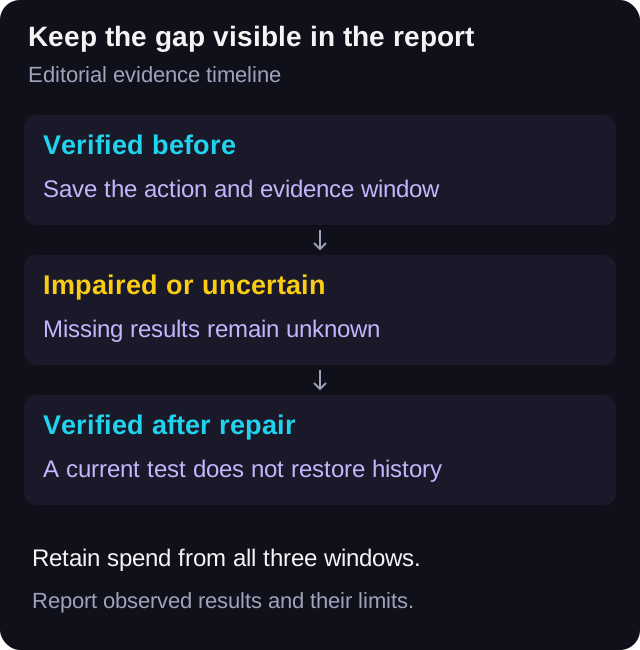
Record the last successful evidence you have, the first failed check, the repair time, and the first verified post-repair result. Put a time zone beside every timestamp. If there was no check between Monday evening and Tuesday morning, the exact failure start may remain unknown.
Use three reporting labels: verified before the issue, impaired or uncertain, and verified after repair. State what verified means for each label. A recorded test checks a particular path at a particular time; it does not prove every device and service worked throughout the whole interval.
Save the campaign export and any relevant event or delivery evidence before changing filters or rebuilding a report. Retain the original reporting window and attribution setting. A report exported after the repair may contain later processing updates, so keep its extraction time as well as the dates it covers.
Preserve spend while labelling the result limitation
Keep the money spent during the uncertain interval in the campaign's total. It still left the ad account even if part of the result denominator is missing. Dropping that spend from the only visible summary makes the release look cheaper than the ledger shows.
You can also present a verified-window comparison, provided its scope is explicit. Put the verified-window spend and its matching recorded click-outs beside the full-campaign spend and observed click-outs. Avoid presenting the first ratio as the full campaign's cost.
For the impaired window, distinguish zero recorded results from proof of zero listener actions. A collection failure can leave you unable to observe the action. Mark the result count incomplete when that is what the evidence supports. If the relevant denominator is zero, cost per recorded result is undefined, not zero.
Check the action before combining systems. Ad link clicks, smartlink visits, DSP click-outs, and Spotify streams have different definitions. A surviving page-view count cannot replace a missing button-event count just because both moved during the same hours.
Show both scopes in a worked report
Here is constructed arithmetic, not an observed campaign. Suppose a verified pre-issue window has USD 15 spend and 30 recorded DSP click-outs. An impaired window has USD 10 spend and eight recorded click-outs, with evidence that some collection failed. A verified post-repair window has USD 15 spend and 30 recorded click-outs.
The full ledger is USD 40 and 68 observed click-outs. USD 40 divided by 68 is about USD 0.59 per observed click-out. Label that ratio as based on the incomplete observed count. It is not a recovered estimate of the true campaign cost per action.
The two verified windows together contain USD 30 spend and 60 recorded click-outs, or USD 0.50 per recorded click-out for those windows only. The remaining USD 10 stays visible in the impaired row. Its eight recorded results are partial evidence, so its apparent USD 1.25 ratio cannot establish that the creative suddenly became worse.
Do not fill the missing count by assuming the healthy-window rate continued. The audience, delivery, or listener behavior may have differed, and the outage evidence supplies no missing-result total. Leave that value unknown and explain the decision limit to the artist.
Require event evidence before calling data recovered
Separate recovered records from estimates. A genuine historical event record can support recovery review because it documents an action and its timing. A projected count from spend or a screenshot of a quiet dashboard does not provide equivalent evidence.
If your technical owner proposes replaying stored events, ask which real records exist, which destination accepts them, and how original timing and duplicate handling will be preserved under that destination's current rules. Use the authorized recovery workflow for the actual integration. This guide supplies no universal replay command, deadline, or promise of restored attribution.
A diagnostic pass has a narrower meaning. For example, Google documents that Measurement Protocol events sent to its validation server do not appear in reports. That validation path is useful for checking requests, but success there does not establish that a production report has been repaired or that historical events arrived. This is a Google-specific example, not a claim that every smartlink uses that protocol.
Before revising the incident report, verify what the receiving system actually recorded. Keep any confirmed recovered count, the evidence reference, and the revised export time separate from the original snapshot. Do not silently replace an unknown with a number that only looks plausible.
Read Google's validation-server reporting boundaryVerify the current paid journey before reading the next window
After a repair, test the actual paid URL through the page and streaming button, then inspect the expected production event. Log the test as QA so the repair check does not become an unexplained result in the next performance read. Verify the intended recording separately from the event delivery.
Record the restart boundary without promising that the platform will immediately return to its earlier delivery or cost. A technical repair and a good ad outcome are different findings. Keep the event definition, report settings, and any changed creative visible so later comparisons have context.
If you use new diagnostic campaign labels, VLVTN's UTM builder can construct that URL. It does not reconstruct lost events or alter an ad platform's attribution. Keep the final paid URL test in the QA register as well, since diagnostic labels do not test every detail of the production route.
Separate repair checks from the next performance windowGive the artist an incident note they can audit
Download the blank register and create a row for each system and evidence window. Include the recorded action, timestamps, spend, observed count, completeness status, evidence source, recovery status, and report extraction time. Keep raw and revised exports rather than overwriting the first version.
A useful note says which measurement was impaired, what period is uncertain, what spend remains in the ledger, what is now verified, and what cannot be reconstructed. If the gap limits a scaling decision, say so. Honest uncertainty is more useful than a precise-looking cost built from invented conversions.
Keep downstream listening separate. A DSP click-out remains the measured handoff from the landing page. Even a fully recovered click-out record does not prove the visitor played, saved, or followed the music inside the streaming service.
Download the blank outage reconciliation registerPrepare a labelled repair-check URL
Use a diagnostic label and record the final production-path check separately. Tags do not recover missing events.
Open the UTM link builder→Frequently asked
Does a quiet report prove my music tracking stopped collecting?
No. Identify the affected system and check collection or delivery evidence separately from its reporting freshness. Google says Analytics reports can change during processing.
Can I estimate missing conversions from my usual click-out cost?
You can label a planning scenario separately, but it cannot be reported as recovered observations. Keep the missing result count unknown unless actual event evidence supports it.
Should I remove outage-period ad spend from the campaign report?
Retain it in the full ledger. A verified-window comparison can be shown separately with its own matching spend and result scope.
Does a successful test after repair recover the historical gap?
No. It checks the path at that time. Historical recovery needs separate evidence that real earlier events were recorded by the receiving system.
Bradley J Simons founded VLVTN and runs his own paid Meta and Spotify ad campaigns as the artist Babbage. He writes about paid music marketing from the buyer's seat, with his own money on the line.
Keep reading
A pre-spend tracking check for music smartlinks: browser event, server event, click-out trigger, and dedup.
How to use GA4, UTMs, the pixel, and CAPI without mixing up analytics reporting and ad optimization.
A reporting checklist for your own release-link tests, with a QA register and a checked cost example.
A practical reconciliation method for artists and labels comparing paid campaigns reported in different currencies.