Compare Music Ad Results After Consent Collection Changes

- →An intentional consent gate can change recorded counts even while the destination still works.
- →An acceptance percentage cannot reconstruct missing listener actions.
- →Observed results and modelled report totals need separate labels.
- →Keep consent choices intact while verifying what the report measures.
Find the collection boundary before judging the creative
You add or update consent handling on a campaign destination. The next export shows fewer visits or DSP click-outs, and cost per recorded result rises. Before replacing the ad, find out whether the report still measures the same population. A deliberate change in which requests are collected needs a different explanation from a broken link.
Write down the deployed version, the first verified time of the new behavior, and the affected measurement systems. Use a named time zone and UTC boundary. If rollout was gradual, or you cannot establish when the behavior reached visitors, mark the transition interval uncertain. Do not invent a clean midnight cutoff from a daily graph.
Preserve the campaign ID, creative, destination, event definition, attribution setting, and report extraction time. Record any simultaneous targeting, budget, or page changes. A release with several changes cannot isolate the effect of consent handling from a before-and-after total.
Align the actual reporting intervals before comparing totalsCheck what the implementation actually collects
A banner screenshot does not establish what a tag sends. Google's consent-mode documentation distinguishes a basic implementation that blocks Google tags without consent from an advanced implementation that can send measurements without cookies while consent is denied. Those are Google-specific behaviors. Do not infer the behavior of another vendor or a custom collector from that terminology.
Ask the implementation owner for a controlled test record covering no choice, decline, acceptance, and withdrawal. For each state, name the page, collector, expected request behavior, and observed outcome. Keep test traffic separate from the campaign report. A working Spotify button and a recorded analytics event are separate checks.
For a concrete product boundary, current VLVTN source initializes its web analytics only after accepted tracking consent. Its optional Google tracking wrapper also renders its children only after acceptance. Those source checks establish the current gate; they do not prove an earlier campaign's coverage, establish legal compliance, or mean that VLVTN implements Google's advanced consent mode.
Read Google's basic and advanced consent-mode behaviorKeep spend, recorded actions, and listening in separate columns
Keep the ad platform's spend for each complete reporting interval, with its currency. Then name the result source precisely: for example, observed DSP click-outs in the destination collector. Do not silently replace that count with platform-attributed conversions, landing-page views, or Spotify streams when coverage changes.
If you have a documented acceptance measure, save its source and denominator too. It might describe banner responses, eligible page loads, or something else. None automatically represents all ad visitors. If the analytics system itself starts only after acceptance, its recorded sessions cannot tell you how many people declined.
Avoid dividing recorded click-outs by an acceptance percentage to fill the missing rows. That would assume the unseen visitors act like the observed group, that the percentage covers the same interval and population, and that events have a one-to-one relationship with people. The report does not establish those assumptions. Record the missing scope as unknown.
Keep Spotify listening evidence in a separate report with its own date range and definition. A consent-dependent DSP click-out remains an observed handoff. It cannot establish whether the person played the song, saved it, or became a follower.
Work through a cost change without inventing the missing results
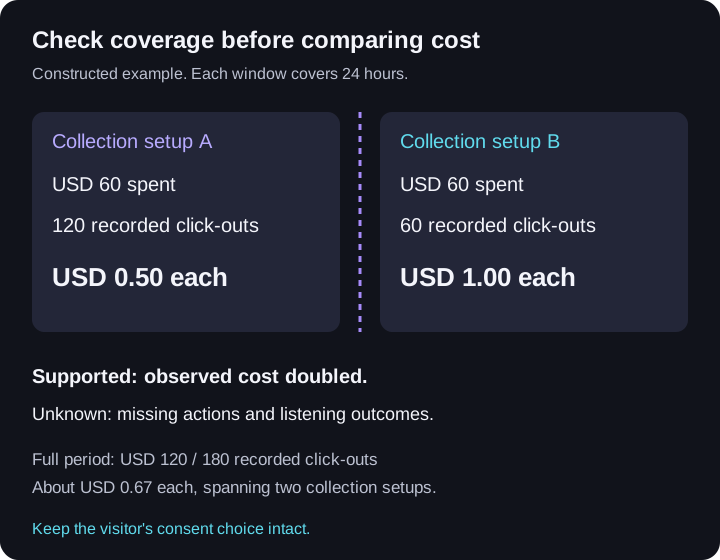
Here is constructed arithmetic, not an observed campaign or benchmark. Window A spends USD 60 and records 120 DSP click-outs under collection setup A. Window B spends USD 60 and records 60 under setup B, which has a verified change in consent-dependent collection. Both windows cover 24 hours and use the same recorded-action name.
The observed costs are USD 0.50 and USD 1.00 per recorded click-out. The second observed cost doubled. That statement is supported by the supplied numbers. Saying that listener acquisition became twice as expensive is not supported: the example does not measure listening, and the coverage of recorded actions changed.
The complete campaign spent USD 120 and recorded 180 click-outs, giving about USD 0.67 per recorded click-out. Keep that full-period accounting if useful, but label it as spanning two collection setups. It does not make A and B a fair creative comparison or estimate the unobserved actions.
If a later window uses setup B consistently, you can start building a baseline within that setup. Still check creative, audience, attribution, and report maturity before making a performance decision. Equal collection settings remove one difference; they do not turn a sequential comparison into a randomized test.
Label modelled report data before joining it to observed events
Google describes GA4 behavioral modelling as estimates based on observed behavior. It has implementation and data-volume prerequisites, and meeting the listed thresholds does not guarantee eligibility. Do not assume a small release campaign receives modelled data because it displays a consent banner.
For an actual GA4 report, inspect the reporting identity and data-quality indication, then preserve what the report says about estimated data. Record the exact report and extraction time. Google's documentation also distinguishes how modelling is applied across reports and explorations, so do not transfer an assumption from one view to another.
Keep an observed collector export and a report that includes estimates separately labelled. Do not add them together as though the estimates were additional verified click-outs. If the report does not expose the separation you need, keep its total in its own row with that limitation. Do not describe a modelled total as recovered event-level evidence.
Check GA4 modelling prerequisites and report indicatorsMake the next spending decision from a verified current baseline
First verify that the advertised recording and destination still work. Then check that the current collector behaves as intended for each consent state. An expected absence of requests after decline should not be reported as an outage. Unexpected collection needs an implementation review, without weakening the visitor's choice to improve a chart.
If collection is working as designed, annotate the change and evaluate subsequent comparable windows within the new setup. Keep business evidence such as actual purchases or available artist-platform listening reports beside the observed click-out read, with their limits. Do not increase spend simply to compensate for a smaller tracked count.
If there is a verified fault, preserve the evidence and use the tracking-outage procedure for that affected interval. Keep the intentional consent change and the fault as separate explanations. A reporting note should say which conclusion the evidence supports and which decision still needs more information.
Use a separate incident record for a verified tracking faultLeave a collection-change note the next buyer can reproduce
Download the worksheet and create one row per source and reporting interval. It contains the deployment reference, consent behavior evidence, recorded action, observed count, spend, cost, modelling indication, and a comparability decision. Leave unknown values blank and explain them in the limitation column. Zero means a verified count of zero, not missing evidence.
Have a reviewer recalculate the cost and read the denominator aloud: which actions, from which collector, among which observable population? If that question has different answers across the boundary, keep the performance comparison qualified. When the recorded count is zero, cost per recorded result is undefined.
Keep campaign URL tags stable while investigating. VLVTN's UTM link builder constructs a tagged URL; it does not estimate unobserved events, diagnose consent coverage, or reconstruct historical listening. Use it for consistent labels and keep this reporting worksheet with the evidence exports.
Download the collection-change reporting worksheetKeep the campaign tags consistent
Build a documented campaign URL, then keep collection conditions and reporting limitations in the worksheet.
Open the UTM link builder→Frequently asked
Did the ad get worse if tracked conversions fell after a consent change?
The drop alone cannot establish that. Verify the collection boundary, result definition, and observable population before attributing the change to the creative or audience.
Can I divide click-outs by the acceptance rate to estimate all results?
That calculation introduces assumptions about unobserved visitors, populations, and event frequency that the observed counts do not establish. Keep the missing scope unknown unless a separately documented method supports an estimate.
Does a consent banner mean GA4 will fill every reporting gap?
No. Google documents implementation and data requirements for behavioral modelling, and eligibility is not guaranteed. Inspect the actual report and its data-quality indication.
Should I remove the consent gate to restore the previous count?
Keep the visitor choice intact. Verify the implementation, annotate the measurement change, and establish a current baseline with documented collection coverage.
Bradley J Simons founded VLVTN and runs his own paid Meta and Spotify ad campaigns as the artist Babbage. He writes about paid music marketing from the buyer's seat, with his own money on the line.
Keep reading
Build an evidence-based campaign report after tracking fails, without turning unknown results into invented conversions.
Build a release-campaign evidence package another buyer can read without guessing the settings behind the numbers.
A practical report-boundary check for release campaigns spanning different clocks, offsets, and local day lengths.
How to use GA4, UTMs, the pixel, and CAPI without mixing up analytics reporting and ad optimization.